A community for posting things related to machine learning
Icon base by Lorc under CC BY 3.0 with modifications to add a gradient
🌉 bridged from !machine_learning@programming.dev by Tidepool

A community for posting things related to machine learning
Icon base by Lorc under CC BY 3.0 with modifications to add a gradient
🌉 bridged from !machine_learning@programming.dev by Tidepool
Currently experimenting with exploration policies for deep RL on Super Mario Bros - Agent is able to beat all levels I threw at it - You can watch the AI learn live
publication croisée depuis : https://lemmy.pierre-couy.fr/post/2152233
I've been playing with deep reinforcement learning for a while. I originally started with a simple DQN, added all improvements from the Rainbow paper, and finally changed C51 for a quantile regression (and plan to swap it for an Implicit Quantile Network). After implementing C51 (which was my first time with distributional RL) I started playing with policies that take advantage of the learned distributions : By independently taking
Nsamples from each action-value distribution, scoring actions by averaging the samples, and picking the greedy action with respect to these scores, I was able to make the agent learn faster than similar agents using only NoisyNets or an epsilon-greedy policy (I'm still using NoisyNet, this is done on top of it). In the limiting cases,N=1is just Thompson Sampling andN=+Infinityis just a plain greedy policy. Finding an optimal value forNproved to be a challenge, so I decided to pick a random value for it at the start of each episode (N = 2**rng.uniform(8,12)for a QR-DQN with 32 quantiles/action works well in my experiments), which led to even better results. I later found out about DLTV which made the agent discover new behaviors, but performed worse than previous experiments overall. Inspired by it, I tried something I did not find in previous works and got the best results out of all my previous experiments : At each time step, compute anexploration_scoreas the ratio of "intra-action variance" over "inter-action variance" (rendered latex equation). I then takeN/exploration_scoresamples from each distribution, and pick an action as described above. (more details at the end of this post) For anyone reading this, I have a few questions : 1. Are you aware of any previous work I missed that tries similar exploration policies with distributional RL (interpolating between Thompson sampling and the greedy policy) 2. Most papers I found about learning from multiple exploration policies seem to be in the context of multi-actor parallelization. Is there any novelty in randomizing the policy parameters at the start of each episode, especially in the single-actor case ? 3. Is any part of what I'm doing worth the time it would take to quantitatively evaluate it ? I've been doing it mainly for learning and fun and have only qualitatively evaluated it so far. However, if there's a chance I can contribute to the field, I'll gladly make some time to compare it to published papers on ALE. ———A few more details
I actually track a moving average and standard deviation of the exploration score, which lets me shift/rescale its values to a target average and standard deviation, and divide N by the shifted/rescaled value. I initially started with a target average of 1 and standard deviation of 1 as well (which gave good results), then tried randomizing these parameters at the start of each episode as well. This led to a lot more diversity in the policies and even better results. Since this worked so well, I additionally randomized the noise strength in the NoisyNet layers. Overall, this made the agent a lot more robust to deviating from what it considers to be the optimal trajectory, and allowed it to learn complex behaviors previous iterations were never able to learn (e.g. taking a few steps back to gain momentum, waiting for good cycles, or dodging hammer bros) ———
Watch it learn
For anyone interested, I made a live stream of the training in progress with graphs and some more details on the experiments I'm running. The current training run was started ~2.5 days ago. The agent has finished and unlocked levels up to 5-1, and is currently learning 5-2. ———
A lot more details

How do you choose which ML algo is best for the given problem?
Hello,
I am new to ML and stuff. watched a video on yt and found that the instructor was brute forcing every algorithm to classify high energy particles. I was wondering if professional data scientist also do this or there are some rules about which ML model to choose.
( the instructor also used a NN to classify which gave pretty good accuracy )
Data Science Handbook | Curated resources (Free & Paid) to help data scientists learn, grow, and break into the field of data science | Andres Vourakis | Last update Jul 23, 2024
Andres Vourakis writes:
Data Scientist Handbook 2024
Curated resources (Free & Paid) to help data scientists learn, grow, and break into the field of data science.
Even though there are hundreds of resources out there (too many to keep track of), I will try to limit them to a maximum of 5 per category to ensure you get the most valuable and relevant resources out there, plus, the whole point of this repository is to help you avoid getting overwhelmed by too many choices. This way you can focus less time researching and more time learning.
FAQs
• How is curation done? Curation is based on thorough research, recommendations from people I trust, and my years of experience as a Data Scientist. • Are all resources free? Most resources here will be free, but I will also include paid alternatives if they are truly valuable to your career development. All paid resources include the symbol 💲. • How often is the repository updated? I plan to come back here as often as possible to ensure all resources are still available and relevant and also to add new ones.

Learn PyTorch for Deep Learning: Zero to Mastery | Free Online Book | Daniel Bourke
About this course
Who is this course for? You: Are a beginner in the field of machine learning or deep learning or AI and would like to learn PyTorch. This course: Teaches you PyTorch and many machine learning, deep learning and AI concepts in a hands-on, code-first way. If you already have 1-year+ experience in machine learning, this course may help but it is specifically designed to be beginner-friendly. What are the prerequisites? • 3-6 months coding Python. • At least one beginner machine learning course (however this might be able to be skipped, resources are linked for many different topics). • Experience using Jupyter Notebooks or Google Colab (though you can pick this up as we go along). • A willingness to learn (most important).

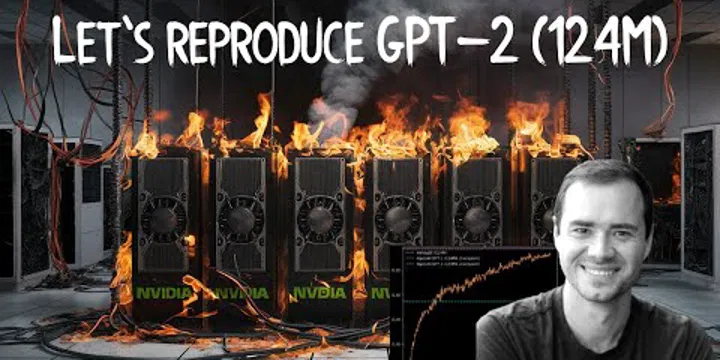
Let's reproduce GPT-2 (124M) | Andrej Karpathy | Jun 9, 2024
 youtube.com
Video description:
We reproduce the GPT-2 (124M) from scratch. This video covers the whole process: First we build the GPT-2 network, then we optimize its training to be really fast, then we set up the training run following the GPT-2 and GPT-3 paper and their hyperparameters, then we hit run, and come back the next morning to see our results, and enjoy some amusing model generations. Keep in mind that in some places this video builds on the knowledge from earlier videos in the Zero to Hero Playlist (see my channel). You could also see this video as building my nanoGPT repo, which by the end is about 90% similar.
Elements of Data Science | Allen B. Downey | July 17, 2024
July 17, 2024 Allen B. Downey writes:
Elements of Data Science is an introduction to data science for people with no programming experience. My goal is to present a small, powerful subset of Python that allows you to do real work with data as quickly as possible. Part 1 includes six chapters that introduce basic Python with a focus on working with data. Part 2 presents exploratory data analysis using Pandas and empiricaldist — it includes a revised and updated version of the material from my popular DataCamp course, “Exploratory Data Analysis in Python.” Part 3 takes a computational approach to statistical inference, introducing resampling method, bootstrapping, and randomization tests. Part 4 is the first of two case studies. It uses data from the General Social Survey to explore changes in political beliefs and attitudes in the U.S. in the last 50 years. The data points on the cover are from one of the graphs in this section. Part 5 is the second case study, which introduces classification algorithms and the metrics used to evaluate them — and discusses the challenges of algorithmic decision-making in the context of criminal justice. This project started in 2019, when I collaborated with a group at Harvard to create a data science class for people with no programming experience. We discussed some of the design decisions that went into the course and the book in this article.
Read Elements of Data Science in the form of Jupyter notebooks.

 View on programming.dev