Skip Navigation

User banner
InitialsDiceBearhttps://github.com/dicebear/dicebearhttps://creativecommons.org/publicdomain/zero/1.0/„Initials” (https://github.com/dicebear/dicebear) by „DiceBear”, licensed under „CC0 1.0” (https://creativecommons.org/publicdomain/zero/1.0/)S
SolarDIY

Members
0
Posts
36
Created
3 yr. ago

SolarDIY is a vibrant community dedicated to embracing the power of solar energy. Here, we encourage you to showcase your ingenious ideas, innovative projects, and inspiring stories, while also seeking valuable advice, fresh ideas, and fostering meaningful connections.

Our passion lies in witnessing the remarkable achievements of individuals who have harnessed the potential of solar energy. Whether you have successfully wired your entire house with solar panels, created a portable solar-powered generator, or crafted an efficient solar pool heater, we are eager to learn from your experiences and celebrate your accomplishments.

Join us on this empowering journey as we explore the endless possibilities of solar energy and inspire one another to make a positive impact on our environment and our lives. Together, we can unlock the full potential of solar power and shape a sustainable future.

Share your DIY solar projects, exchange knowled…

🌉 bridged from !solardiy@lemmy.world by Tidepoo

I won't tell the electric company I installed a PV system, but there will be signs...

Image is a graph from the electric company showing my usage for a day this week. From 6:30 AM to 8:30 PM we used absolutely no utility power.

I'm almost at the three week mark for having this system up and running. The first two weeks I only had 3 KW of PV input but I added another 5 panels to bring it up to 4 KW last week. It's also still running from a transfer switch in "off grid" mode because I don't yet have the prep work done to move my breaker box and start moving circuits to it. (That means I'm either on full solar+battery or utility, no mixing or load sharing).

Once I get it wired in fully, I'm probably going to switch to time-of-use billing. Unfortunately, I can't do that ahead of time because rather than just making off-peak use cheaper, it makes peak usage (M-F 7am to 9pm) extremely expensive while off peak dirt cheap. I wish there was a middle option, but it is what it is.

I'm also being very conservative with my battery usage since I want to have at least 50% in "reserve" to cover power outages. That's especially important during these heat waves. We could easily run 24/7 but would have to take a day off every so often to just let it charge back up since my system is a bit too small to cover all our usage indefinitely (at least if we want to run the A/C for comfort, that is).

Woo! My first solar system and it worked!

For nearly three hours my house was running off solar. Still more work to do and a ton of add-on batteries to buy, but the system works. Eventually I want to replace the manual transfer switch with an automatic switch that I can run from anywhere. I designed the system and picked the components but hired an electrician to do the permitted installation. Passed inspection yesterday. And today, of course, cloud cover! Come on, man! I want my photons!

Already seeing significant savings despite my PV system having only been running since the last week of June.

We've been running the house on mostly PV since I got the initial install done at the end of June. I ran some smaller loads from it throughout June while I was testing the equipment, but that was kind of ad-hoc.

Just now coming out of a heat wave that started last Monday, and most of the A/C usage has been from solar. Still running from the "temporary" transfer switch hookup, so I'm not yet taking advantage of the "hybrid" aspects of the inverter. That may be a while since I have to do some more prep work before I can start installing the new breaker box and moving circuits over to that.

I've also ordered the fourth rail and 5 more panels, so I should have this upgraded from a 3KW to a 4KW system sometime later in the week. Would have ordered those earlier, but I didn't want to make the UPS guy deal with them when the heat index was 109 degrees lol. That, and I wouldn't want to deal with them in that kind of heat, either.

It's just nice seeing such significant returns this early in the process.

The one hour a day the sun is in perfect alignment with my panels, and the only dark cloud in the sky parks right over top of me. I'm trying to not take that as a metaphor for life 😆

Edit: As suggested in the comments, shaking my fist and yelling at it has, thus far, proven unsuccessful. The cloud appears to be an obstinate one.

Got the first rail mounted today

Took me a while on this because I kept dropping my tools and parts off the roof 🤦‍♂️but I'm hopeful the rest of them should go a bit smoother. I've also kind-of, sort-of gotten comfortable working up on the roof. I love metal roofs for their not-leaking and longevity, but I hate working on them.

There are 5 panels per rail, and I've got two more rails (10 panels) left to go.

Another bit of good news. My measurements were wrong and I can fit four rails up there instead of the three I assumed. That's also why the panels are off-center on the mount. That brings me to 4 KW instead of the 3 I mathed out. I only have 15 panels, so will have to order 5 more and some extra rails and mounting gear. I'm probably going to do that soon so I don't lose momentum. Now that I know I can do 4 rails, I may split them into two strings of 10 instead of one string of 15. That should give me some wiggle room if there's partial shading later in the evening.

Next steps are to get the other two rails installed (tomorrow) and document the string configuration and figure out which direction I'm going to run the DC cables (off the side of the house or down the front. And from there, measure and go buy the conduit for them.

Pre-Install

My whole house has been on solar for the last two hours

I'm doing pre-install system testing before I get started on the real install later this week. Wanted to make sure all the components worked before I went any further. They've basically just been sitting in boxes in the basement since April.

Hooked up six of my 200W panels in a string and temporarily wired the inverter into the breaker panel to make sure that:

• Inverter was getting power from PV • Inverter was charging the batteries from PV • Inverter was outputting power • The output was proper 120/240v split-phase (I tested that with a multimeter before hooking it in) • The battery-to-battery communication was working • The communication settings between the batteries and inverter were correct • All the panels fit on the mounting rails and that my measurements were correct

All systems green!

The only thing that caught me off guard was that I mis-read the input voltage ranges for the inverter. DC input minimum is 120v but the MPPT minimum was 140v, so nothing was happening at first and it was only drawing from battery. I had planned to test with a string of 5 but that was just under the MPPT minimum so I had to lean a 6th one up against the 5 I had on the mounts.

The only untested mode is splitting the power input between utility AC and PV/battery. Due to the temporary way I have this hooked in, I can't really test that. I'm also only able to test the inverter at half load since I only had a 30A breaker on hand to wire it into the main panel.

For people using Daly BMS, there is an open source app for monioring/logging (for Linux mainly)

DALY BMS Python Interface

A Python implementation for monitoring DALY Battery Management Systems (BMS) via Bluetooth Low Energy (BLE) on Linux. This is a command-line replication of the DALY BMS Android app functionality, designed to run on Linux PCs.

gitlab.com

If an inverter has dual MPPT inputs, do those have to be at the same voltage or can they be dfferent?

The inverter is an Eco-Worthy 10KW unit which, like many others you can buy, is just a re-badged SRNE inverter.

It's got two MPPT channels, and the PV input voltage range is 100-500v DC.

I'm planning the layout and wondering if I can have my main string of 12 south-facing panels in series going to MPPT1 at 288 volts and a secondary string of 8 panels going into MPP2 at 192 volts. Trying to make the most of my limited west and south-facing roof real estate.

I can definitely ask the manufacturer support, but figured this was a basic enough question I'd ask here first and possibly get an answer faster.

Just doing a heckin' science to figure out my solar system requirements... How much battery capacity do I really need? (No, really -- I'm asking!)

I'm planning to cut my grid connection and go full off-grid. Which raises the question of how much capacity I really need. And what you see here is me trying to answer that question based on ~51,000 5-minute data points of usage data my power company provided to me, complete with custom-made python script to parse all that data and pretty charts! (Yes, I have 6 monitors. And this kind of shows why.)

And what I'm really torn about now is how much battery capacity I need. Should I get enough to cover the absolute worst case scenario (66kwh) or is something closer to my average overnight usage (20kwh) acceptable?

Not the absolute end of the world if the batteries run dry and I need to temporarily supplement with generator backup, I suppose. Nobody is life-or-death depending on any electrical appliances here, and even on the coldest days, waiting a few minutes to go start a generator isn't a huge deal.

But definitely would like a word from the wise about how much battery capacity I really need. And also how much solar panel wattage I need, I suppose.

Solution for storing batteries in an unheated outbuilding?

I am looking to mount my solar panels on an uninsulated pole barn about 30m from my house.

Does it make more sense to route my 48V dc lines to my climate controlled house or should I build a climate controlled space for just my solar inverter/batteries in my barn?

Are there any off the shelf containers for battery storage? Like a chest freezer designed to keep the interior at 15c?

The system will be hybrid grid tied with about 7kwH of battery capacity. My house is very shaded, but the pole barn is not. That is why mounting panels on the house is not an option.

Conclusion: After reading all your input I think I'm going to build a tiny room in my pole barn with insulation and a ductless mini split in there to maintain a stable temp/humidity over the year. It's a headache, but it's going to be cheaper than giving up 25% of my power to DC resistive losses or killing my battery's life.

Thanks for everyone's input.

Battery fuse per-string and also main parallel fuse both required?

I have a 300Ah 12V LiFePO4 battery setup with three 100Ah batteries (internal built-in BMS in each battery) in parallel. I have it fused at the parallel junction with a 400A fuse.

I want to put a 125A MRBF fuse on each battery instead. If I do install per-battery fuses, is there a reason to keep the combined big fuse as well? I see wiring guides recommending both but I'm not seeing any explanation for why.

The reason for moving is that the current fuse gets way too hot when pulling 300A sustained. I don't have room in my setup to easily install the really big fuse holders with heat sinks that are made to handle 300+A sustained current. (Yes, I checked the voltage drops across all my connections. They are very low. It really is the fuse getting hot and not a weak crimp etc.)

Which 4.2V solar charge controller is better: SD05CRMA vs. SDBK03TA 4V2

I need a small solar charge controller for a 4.2V battery and a 5V solar panel. In my research, I found the SD05CRMA and the SDBK03TA 4V2. Both use a 472 and a 1201 resistor. They both also use a CN3163 mppt lithium ion battery charge controller. I see no other differences besides price. Are there any benefits of one over the other in terms of physical architecture? SDBK03TA SD05CRMA

How hot are high-current fuses supposed to get?

How hot are fuses supposed to get / what kind of voltage drop is expected? I built a system which should allow 300A discharging (1C) / 150A charging (1/2C) But if I run more than 60A, my main battery fuse gets hot. If I run 300A the fuse get rapidly gets too hot to touch, and the heat spreads through to the attached cables, the battery, and the temperature sensor on the positive battery post. Is this somehow normal?? I’ve tried three different types of fuses with no real improvement. photo of fuse installation with voltage drops while drawing 60A only — Here’s a photo of my installation with voltage drops labeled at 60 amps draw only. I don’t have voltage drops measured for the 300A draw because I don’t want to leave it running that way for long. The main fuse on the battery is a 400A ANL fuse. I’ve tried with a 300A MRBF fuse and with two 150A MRBF fuses in parallel. All of them get hot to the touch when drawing over 60A. Help?

Finally got together a simple 12-24v DC bulb light fixture for the offgrid solar power system

To see at nighttime ive been getting by with a 5v USB bulb for a while now. Its adequate and power efficient lighting for sure. But honestly I dont want adequate, I want the luxury of nice bright dimmable lighting.

I bought a cheap string light fixture, a male car cigarette outlet connector, and some 12-24v bulbs.

The string fixture had come with home ac outlet plug, so that needed to be cut off and replaced with a DC comparable outlet plug. Theres a few options but for now I choose a car cigarette plug male. I wired it together and plugged it into the 12v system, the bulb works nicely. Its daytime now so excited to test out and see how much of an improvement it made.

It would be nice to wire up a dimmer and intelligent microcontroller or radio frequency controls. I could get a three way socket adapter to put in a couple more bulbs but that may not be necessary.

Inverter sizing calculator

I've added an inverter sizing calculator to my website WattBuild. The goal is to establish what devices will be used, and to calculate continuous and surge power requirements using typical loads from our device research. Open to any feedback!

Solar Bikeshed

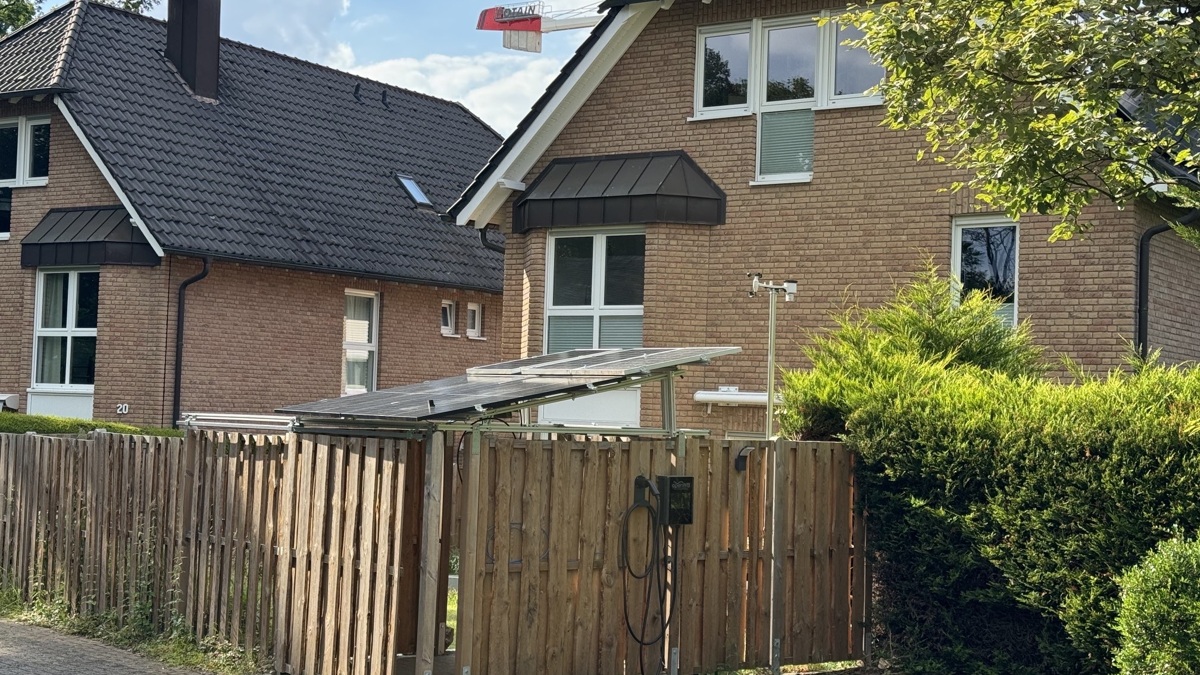
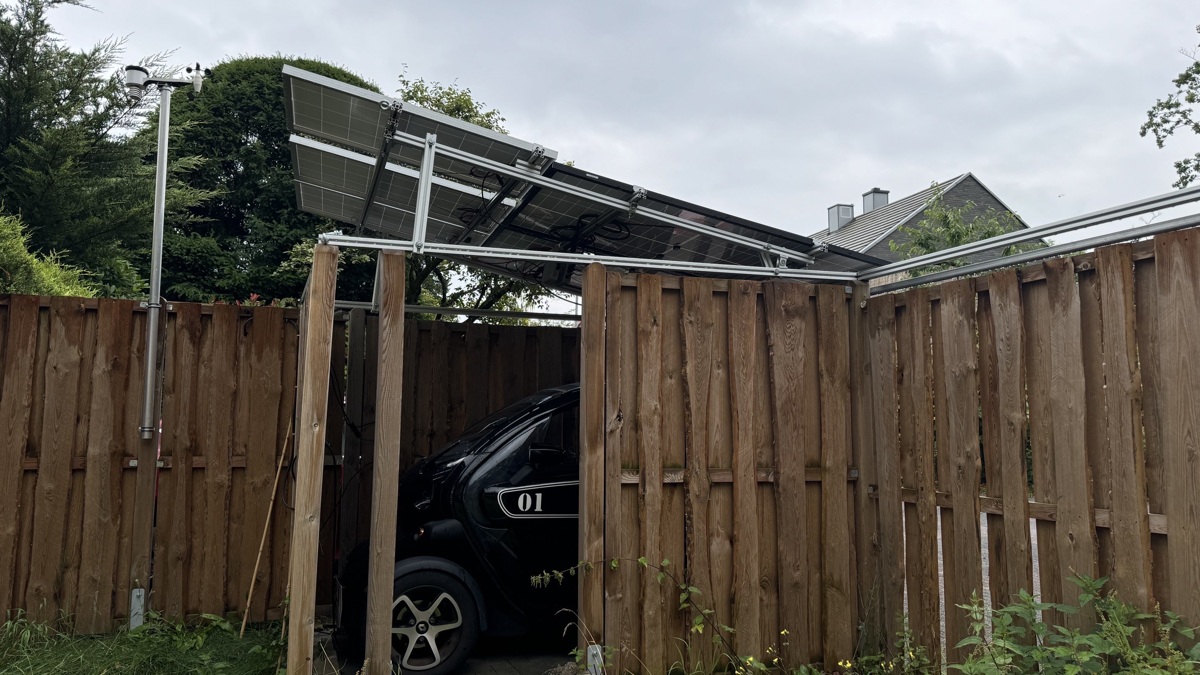
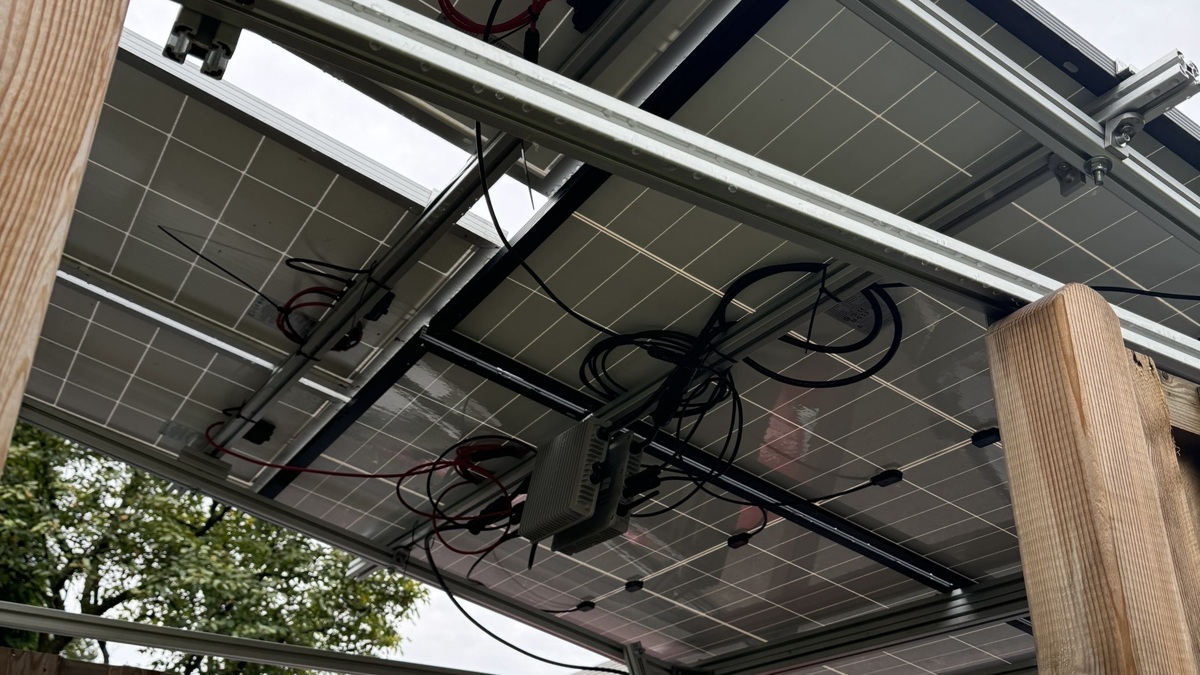
cross-posted from: https://natur.23.nu/post/12050 I wanted to park my bikes - or depending on the Season - my Renault Twizy somewhat protected and easy accessible. After adjusting the yard fence to form a pocket I put a frame aluminium profiles on top. On top of that is a second frame which is angled at 10 degrees and on that are the solar panels. 10 degrees seem to be a viable compromise between self cleaning, sun capture, construction height and openings to the elements on the side. Image: Frontal view on solar bikeshed It was much more challenging than i thought to find solar modules with a form factor fitting the shed. 4 Standard modules where far to big. So I choose two modern 410 Wp modules and 3 130 Wp “camping” modules. I got two 600 W dyne (“Bosswerk”) Micro-inverters cheap, because everybody want’s 800 W now and they have a regulatory issue with a missing relay. Twizy Micro EV parking in solar Bikeshed The 130 kWp panels are cabled serially but still seem to have issues getting enough voltage to start the inverter in the morning. two Micro Inverters below 5 Solar Modules I’m happy with the project. Things in the shed are getting much less wet during rain und not baking hot during sunshine. I might close the gaps between the panels obe day but that is low priority- the thing was never meant to be totally watertight. I also like it being some kind of Solarpunk landmark in our street.

Unreasonably pleased when I can charge from excess solar

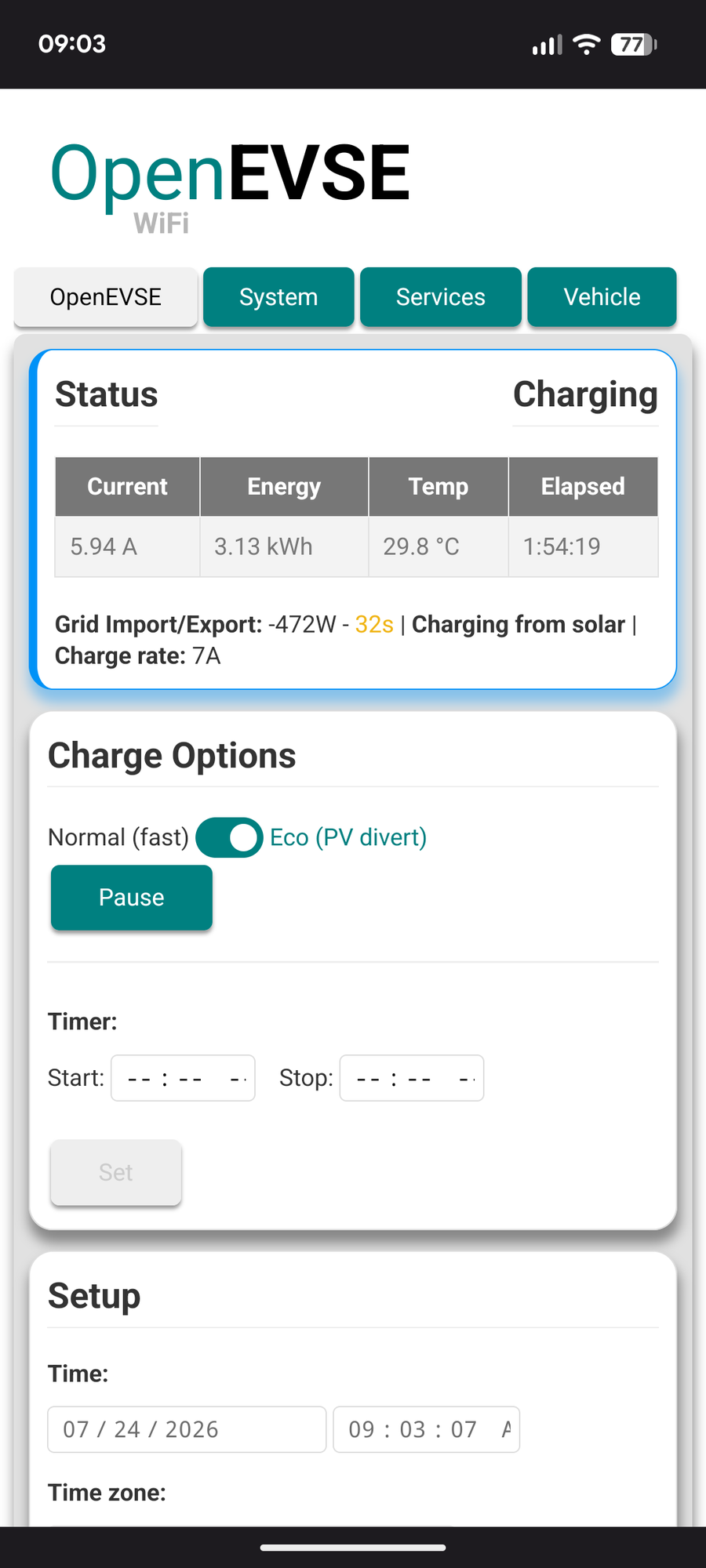
cross-posted from: https://piefed.social/c/energy@slrpnk.net/p/2233823/unreasonably-pleased-when-i-can-charge-from-excess-solar Additional detail for DIYers: I used vuegraf to publish MQTT from my Emporia Vue, which OpenEVSE can natively consume.

I somewhat recently connected Emporia Vue's 'net production/consumption' metric to my OpenEVSE so I can make use of the 'eco divert' feature that only charges from excess solar production. Since my utility charges for transmission of net-metered power, this leads to some savings. When we have cooler summer weather it shows up very nicely on the graph. EVSE view: OpenEVSE eco divert (Hopefully this is OK for this community. Not news, but could be a nice highlight/discussion. If not, glad to find another spot to share it.)

Help with JK BMS and Victron

Hello. I recently bought an off-grid house with its own solar system. So I'm learning little by little. Right now, I have a Voltronic Axpert VMIII inverter connected to two battery banks. These battery banks have 16 batteries each, totaling 32 batteries (LiFePO4). Each bank has a BMS model JK B2A20S20P. There is no communication between this inverter and the BMS; everything works based on voltages, meaning I have told the inverter what voltage it should have. I am going to upgrade my installation with more panels, a Victron MultiPlus-II 48/10000/140-100 inverter, a Victron Cerbo GX MK2, a VICTRON MPPT 250/100-Tr VE.Can, a VICTRON MPPT 250/70-Tr VE.Can, and some other things that I don't think are important right now. My doubts arise about whether it will be possible to connect the BMS of the battery banks to the Victron system so that it can manage the batteries correctly, or if it is better to buy new BMS that do allow this. What do you think?

If I should buy a new BMS, which one do you recommend for this case?

Thank you very much!

Edit: Added type of batteries Edit2: I'm from Spain

DIY experimental Redox Flow Battery kit

cross-posted from: https://lemmy.world/post/33224011

The guys at Flow Battery Research Collective have been designing a Redox Flow Battery development kit that you can build yourself using a 3d printer and a few tools. It's a desktop size flow battery that you can use to either do your own research, e.g. on different electrolytes or just to replicate their experimental findings. Redox Flow Batteries have the potential to become grid scale or home electric energy storage solutions that are way better for the environment than current lithium based batteries. They can often scale power and capacity independently and allow for repairs. The FBRC project wants to spread the knowledge on RFBs and help kickstart a global community that develops sustainable energy storage technology in an ope source fashion. Beware that the project is still in its infancy and sourcing the materials can be a bit of a challenge. Be sure to ask around in the forums for help!

fbrc.dev