A 50-something French dude that's old enough to think blogs are still cool, if not cooler than ever. I also like to write and to sketch.
🌉 bridged from @Libb@piefed.social by Tidepool


@libb.piefed.social.ap.tdpl.io
6 Posts26 Comments0 Memberships
Joined September 2026
A 50-something French dude that's old enough to think blogs are still cool, if not cooler than ever. I also like to write and to sketch.
🌉 bridged from @Libb@piefed.social by Tidepool
I purchased new notebooks
They're are lined, A5, hardcover notebooks. Kinda like Moleskine but unbranded, made in China.
I recently purchased two of them, in some nearby discount shop (near Paris, France). At 1,99€ each this seemed like an excellent bargain and after using one for a couple weeks or so, I went back to the store this very afternoon and purchased the few that were left.
Exciting as it already is, I need to point out that this purchase saved me quite a few bucks compared to regular branded-notebooks, as I now own 8 notebooks for (less than?) the price a single branded one... A brand whose notebooks are also made in China, btw.
If that was not exciting enough already: being there for the second time in a few weeks, I took the opportunity to buy a few extra packs of "10 Cristal Bic", at 1,49€ per pack (0,15c/pen).
Sometimes, it feels like my life is way too exciting.
Simple DIY Hack: Portable Writing Board
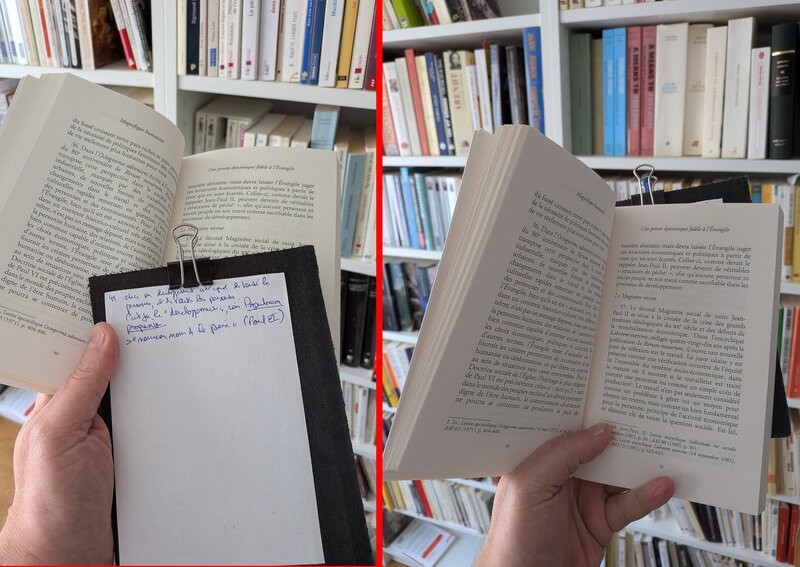
First, I'm not sure it's ok to share such a simple hack that it barely deserves to be called a hack. Second, the link points to my own blog (fear not: zero ads, zero tracking and, nope, I have nothing to sell you either. It's content freely shared at my own expense, like most blogs once used to be: a personal space to actually echange content and ideas with our fellow human beings, and with a smile). But I do find this simple, cheap (it's 100% made out of reused/recycled stuff) and dirty little hack very useful as it allows me to much more easily take notes while reading a book, or whatever else I may be reading even good old newspapers. No matter where I'm, be it comfortably sat at home or anywhere I may be reading and taking notes... Yesterday, I spent 5 hours or so at the local Emergencies to be checked by a doctor but I was able to work almost as comfortably as I would have done at home thx to a stupid piece of cardboard very much like this one: jvQ2zn7OJglUvNP.jpg With time, I've devised a few different models (I think I show two models in the blog post, but there are a few more. My latest attempt is made out of... I don't know the English word for that very lightweight extruded plastic of various thickness used to make signs (house for sale, and crap like that), it's also very light. It's the first model I've not made out of some sort of cardboard and also is the least usable one, by far: that plastic is not great for writing on (the pen will punch through the thin surface the second one presses too hard. These boards all share the same basic idea: • a flat surface to write on and to hold fast the loose sheet of paper (I use A6, one can obviously use whatever size they prefer), • A surface that is not too large (my latest versions are approx A5-sized, even though I use A6 sheets as it leaves more room to rest my hand on while I write), so I can easily carry it around with any book I'm reading. • A way to hold spare sheets • A way to hold a few pens, safely as I don't want to risk losing them when I'm carrying it around. I need at least one pen but will sometimes use up to three, including a colored mechanical pencil for highlighting, depending the book I'm reading. More photos and a few explanation on my blog: A Portable Writing Board
Literary supplement of Le Figaro about writer’s diaries
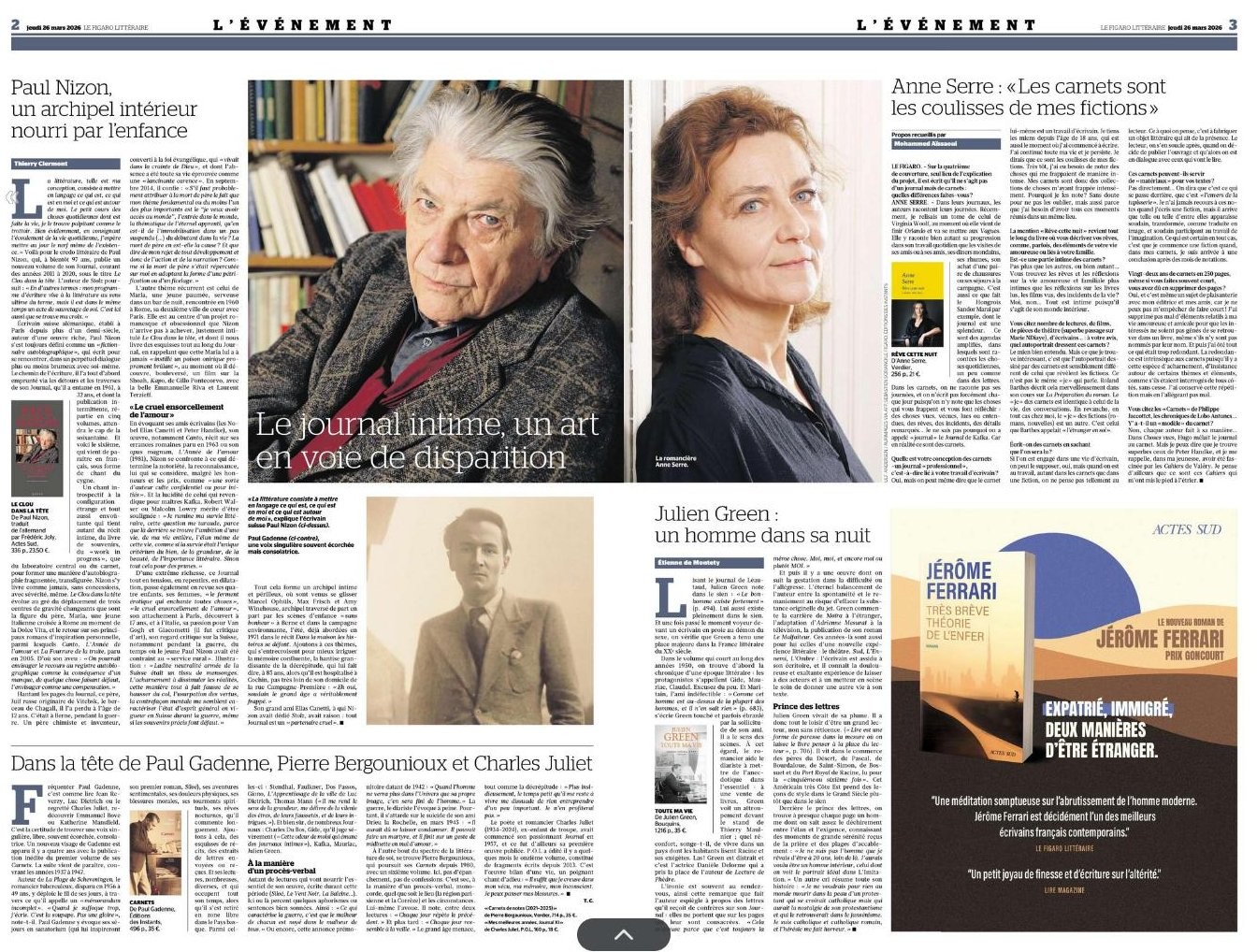
The French daily newspaper 'Le Figaro' (celebrating its 200th birthday this year) published yesterday its literary supplement 'Le Figaro Littéraire'. Its front page is dedicated to the (dying) art of the diary: 'Journal intime, les derniers feux' says the French original title, which I would translate as “Diary: a Fading Art” but literally translates as “Personal diary, the last embers”. Beside the front page, the supplement only dedicates two pages to the topic, and only talks about published/famous writers keeping a diary, not saying a word about mere people keeping a diary but that’s ok. The screenshot is probably unreadable but I thought you might be enjoying having a look at that double page to see what it was like inside: GRFEj0k13nrIuC8.jpg BTW, if you read French, I consider Pierre Bergounioux’s and Julien Green's diaries remarkable (they are two of the names mentioned in those two pages). (and, yep, I'm one of those people who do read print newspapers daily, not their online version. I read one in the morning and another one, from another political side, in the evening)
A brief (?) presentation of myself and how I use pen and paper
Hi, I just joined and since I can see no other post (indexing issue? or is the community that recent? ;) I thought maybe I could post something. I’m nearing my 60s and I’ve been using pen and paper most of my life. From school—even it was already on its way out back in the early 70s kids were still taught handwriting using a fountain pen, at least here in France—up to this very day. Privacy is is one of the two reasons I still use pen and paper instead of any of the many apps and services I have tested and learned to use. The second reason being the… satisfaction handwriting brings me. I’m considered a decent typist (I got my first Apple computer in the very early 80s, and a few years before that I was quite happily writing shitty stories on my grand-dad’s already old Olympia SG1 typewriter, a wonderful machine on which I learned to type… and to stain my fingers, playing with the ink ribbon :p) but nothing beats the simple joy of writing in silent, hand on paper. Early in the morning (most of the time, I like to write between 4AM and 8AM while my spouse is still sleeping and while the city around us is still quiet) I draft most of what I write longhand, using loose leafs (I prefer the flexibility of being able to move the sheets as I see fit, that’s also why in the 90s I was so obsessed with Filofax) and either a (mechanical) pencil or a fountain pen—those two device are friendly rivals in smoothness (depending the paper) and, unlike most ballpoint pens, require no effort at all to write, the hand doesn’t need to press hard quite the contrary, which helps write longer & with less fatigue. I also journal longhand. I have been doing so since I was a (not that happy) little boy. Talking journaling, I’m the admin at !journaling@sh.itjust.works which has been on a bit of a pause but the place is open and do welcome people willing to post content, tips and tricks, questions, suggestions,… The community is open to both analog and digital journaling, btw. But my main use of pen and paper is my Zettelkasten, aka an endless pile of index card (A6) that I keep organized and indexed. It’s the place where I store all my reading notes (I read a lot, and always take notes while doing so), all the references, quotes, ideas and any type of content (text, images,...) I want to be able to quickly refer to later on when I work on one of my own projects. Lhumann, the dude that formalized this concept of Zettelkasten (which is in reality much older than that word, people have been using it for centuries) described his Zettel as his second brain. And he was right. That thing is not just a passive pile of cards. It’s smart and it can often be surprisingly… stimulating to browse through it. Just flipping through a bunch of cards will often bring unexpected ideas. It’s a true partner with whom one can have a meaningful discussion, like when one is reading a book, a good book I mean. Here is the two most important tips I can think of for anyone wanting to give it a try: 1. Keep it simple. The key to a Zettel is the numbering/indexing. So keep the numbering simple (it can always evolve later on if you feel the need to). Also, don’t try to anticipate all categories, projects, whatever you think you may one day need. Start with what you actually need now (say in regard to a specific writing project/research you're working on) and let your Zettel grow by itself as you go along. It’s one of the things that make it so powerful: it will grow with you. And, yes, this also means some part of it will not grow that much if at all, and some may even become stale, and you need to be fine with that. 2. There is no need to spend a fortune on fancy materials, a nice fountain pens, a large pack of expensive index cards and luxurious storage boxes. Start with what you already have. • Index cards: I use the back of old letters, recycled invoices, whatever decent paper I can get my hands on that I can cut to size (one A4 sheet makes four A6 cards, and it’s easy to cut of them using a massicot). Index cards are sturdier, that's true but they’re also (a lot more expensive and) thicker and if you start really using your Zettel you will quickly realize space in your storage box quickly becomes an issue. Also, most of the times those cards will be neatly stored in that storage box or laid flat on your desk, they don’t need to be that sturdy because they’re not, say, library cards. • Storage boxes: I made my own out of… cardboard that I cut and assemble. If anyone is interested, I may post a short guide on my blog explaining how I do that but it's really simple (one only needs some spare thick cardboard from a delivery package, white glue and a cutter/hobby knife) and it’s really sturdy. Before that, I used to use old...shoe boxes. Edit: typos and a missing sentence.
A new privacy-respecting journaling app?
Journiv is in early beta and I have not been been able to install it, at least not yet as I asked the dev if they could help ignorant-me, but the app sure looks nice and it promises privacy (control of our journal) to its users, the lack of which being the main reason why I quit using Day One years ago, going back full time to analog journaling. So, if you're more tech-savvy than I am or have more brain power than I have (which should not be difficult) and you manage to install the app, feel free to share your experience with all of us and with the dev who is asking for user feedback. Via.
Notebook & pen(cil)
I'm afraid, my post may not respect rule #2 as in reality it's a multi-purpose tool but one that can only single task too. Allow me to explain ;) I take all my notes (and drafts absolutely everything) using a pen(cil) and paper, either in a pocket notebook or in a custom-made A5/A6 notebook (nothing fancy but if you're curious its latest iteration is visible here, the post in French but the photos should suffice). I love this setup a lot more than I ever liked writing on a computer/device. I've been using a computer since de early 80s and I'm a decent typist, most of what I write will end up in a digital form of some sort so it's not like I'm a Luddite. It's just that I prefer the unrivaled tranquility of the pen/paper combo, it's incomparable portability, and both it's slowness and unrivaled speed. • No distractions, no notifications. No ads. No Fomo. • No tracking or spying either. • No batteries, no upgrades, no updates, and no crashes. • It's sturdy as it can withstand me sitting on it (my pocket notebook is often stored in my jeans back pocket). Heck, even if I teared my notebook to pieces I could probably still use it ;) • It works well under the sun, when the weather is as hot as a politician's promises of much better tomorrows, or when it's as cold as a banker's heart (when it's that cold, a pencil is probably the better choice compared to fountain pen or a ballpoint pen). And it can be used when it's raining too. But how can it be slow and fast at the same time? If you can touch type, writing longhand is slower. I'm not a pro typist but I type much faster than I trace words on paper, even in cursive. But this slowness is also a great opportunity to not rush things. And then, that slowness is apparent only because, along the years, I've devised my very own shorthand that makes it so I can write longhand at least as quick as I can type. Plus I can freely mix words and quick sketches using the same pen/notebook. It's a highly focused tool that beyond its apparently very limited capacity—it can do a single thing at a time only, and it has no CPU and no RAM to speak of... beside the very little that sit between my ears, I mean—that can still do a lot of very different things: • writing: todo, errands, ideas, fictions, poetry, a love letter, or just an address. And so on. *drawing/sketching. Depending the paper, one can also do watercolors or gouaches. • Do some math. • play games. • Quickly draw a map/plan to go some place. • keep info you need, • It can also be used to share info... by removing a sheet of paper (say, the love letter you just wrote) and give it to someone (no that was not how it all started for little kid-me back then when I was sending love notes on pages, whose pages I teared of my composition notebook, to my sweetheart while we were both very intensively not listening to the teacher :p • And it can also do origami quite well, if you're into origami.