Icon base by Lorc under CC BY 3.0 with modifications to add a gradient
🌉 bridged from !privacy@programming.dev by Tidepool

Icon base by Lorc under CC BY 3.0 with modifications to add a gradient
🌉 bridged from !privacy@programming.dev by Tidepool
US surveillance ruling 72 days overdue for release, privacy group EPIC sues
Renewed March 17, Section 702 lets officials compel US tech providers' help until March 2027. The ruling stays secret while Congress weighs renewing the law.

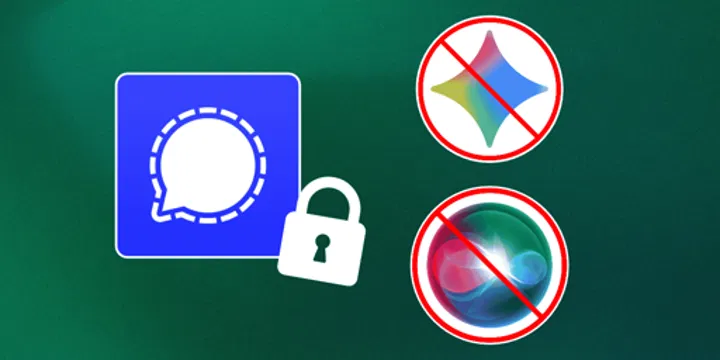
Signal Takes a Radical Step to Block Gemini and Siri From Reading Your Chats
Using a privacy-focused messenger like Signal is a good idea, but AI assistants now baked into recent smartphones, such as Google's Gemini and Apple's Siri, can read whatever is showing on the screen. The president of the Signal Foundation, Meredith Whittaker, says this leaves the messaging app between a rock and a hard place, as operating system makers have not given apps good ways to block AI access to their data. This leaves Signal to make do with the tools it has. Its open source code and encryption protocol have backed its privacy promise for over a decade, but neither helps once the operating system starts capturing the screen. Whatever the assistant picks up gets stored, and where it ends up is down to the OS agent, be it a local database or a remote server. Signal has no control over that. The risks Your phone is not the only one that matters. A chat shows up on every participant's screen, and Signal says an assistant reading any one of them can potentially expose everyone in the conversation. On Android, the answer is to turn on Screen security automatically the first time an AI assistant tries to read Signal's screen. This needs you to be on Signal 8.35.1 or later. The app relies on detection because Android differs from vendor to vendor, and many phones give it no reliable way to spot a screenshot attempt once screenshots are blocked. Not every Android phone gets this protection because it depends on Signal being able to notice an assistant at work. On iPhones running iOS 27 and Signal 8.37 or later, a new "Block Siri AI" setting is enabled by default. It blocks screenshots and screen recordings inside the app and hides the app from the App Switcher. Anyone who tries a screenshot gets a message with several choices, and the setting can be switched off entirely or for 10 minutes only. Signal calls the fix incomplete because content can still be pulled from the filesystem, and turning the protection off can potentially expose your content and your contacts' content too. Macs are left out as well. Signal says macOS offers no way to restrict AI access without a major hit to the user experience, and that is why the protection is missing there for now. Signal wants a developer opt-out the signal homepage Signal first tried this on Windows 11 last year, when it used screenshot blocking to keep Recall away from chats. Its ask has not changed since. Signal wants Apple, Google, and Microsoft to give developers an easy, documented way to opt apps out of AI data access, along with better documentation of how these agents work. It says it is hopeful, with some caution, about its talks with Google and Apple. Interestingly, users do have some controls of their own. The EFF says that iOS 27.2 added an "Excluded Apps" list that stops Siri AI from reading any app on it. What stands out to me is how little control an app has over this. Signal can block screenshots and watch for assistants on some Android versions, but the outcome still depends on each person's phone, OS version, and settings. That matters in a conversation with several people, since one person switching the protection off can potentially expose the rest.
Has AI just cracked Internet [public key] encryption? Rumoured ‘bombshell’ stuns scientists
Paywall bypass: https://archive.today/Wuk90
Several researchers say they have heard that some of the leading AI laboratories have discovered algorithms capable of breaking public-key cryptography in ‘polynomial time’ (or ‘P’ in computer-science shorthand). Public-key cryptography helps to secure everything from banking apps to Internet browsers. It relies on mathematical problems that are considered practically impossible for computers to solve within a reasonable amount of time.
In practical terms, an algorithm that could break public-key cryptography in polynomial time could undermine much of the security on which the Internet relies.
If one of the common public-key systems were indeed found to be vulnerable, its discoverers would face difficult choices: make the algorithm public, allowing others to develop defences against it? Keep it a secret? Or perhaps announce what the vulnerable system is, without revealing how to break it?
Unless all available public-key systems are broken at once, AI labs and governments should alert the relevant institutions — such as the companies that handle Internet security or produce popular Web browsers — that they should urgently update their systems, researchers tell Nature. “I believe companies should follow responsible-disclosure practice if they really have a practical attack,” says Yu Yu, a cryptography researcher at Shanghai Jiao Tong University in China. “That is, they should tell the world that such an algorithm exists without disclosing the details, and give the world a grace period to migrate to risk-free infrastructure.”
Google Will Soon Start Showing App Dev's Phone Number and Address on the Play Store
Google has given every active developer on the Play Store until February 1, 2027, to say if they count as a trader. Developers whose apps aren't delivered in Europe have to answer too, and so does anyone opening a new account. The part that matters comes a month later. From March 1, individual developers who declare themselves as traders will have their phone number and address shown on their app pages to users in every country. Miss the deadline, and Google can block your app updates or pull your apps from the Play Store worldwide. Who counts as a trader? Google leaves that call to the developer. Regular income from an app is the clearest sign, whether it comes from ads, in-app purchases, or paid downloads. Running it as a business, handling a lot of transactions, or holding a D-U-N-S number point the same way. Hobby projects are unlikely to qualify, but Google won't rule on individual cases and tells anyone unsure to ask a legal professional. Calling yourself a non-trader when you clearly are one can get the account suspended or terminated. Developers whose apps stay out of the EEA and the UK can pick the non-trader route. Users in those regions then see a notice saying consumer rights don't cover their dealings with that developer. What will users see? Along with the phone number and address, a trader's app listing shows the D-U-N-S number under the "App support" category and a link to the app's terms of service. EEA and UK users get a bit more, since the developer's name replaces Google's in the "Offered by" field, next to a promise that the developer follows local law. Google takes the address from the account's payments profile. It has to be a physical address that matches official documents, and PO boxes are turned down, so changing it means editing that profile. Is Google asking for too much? I think this is the latest in a long line of asks. In 2023, Google added an "About the developer" section to Play Store listings and made new organization accounts supply a D-U-N-S number. Android is also getting its own developer verification for apps installed outside Play, with plans to take it global in 2027. Europe's rules are the reason behind all of this, and wanting traders to be reachable there is fair. What I don't get is why a user in another country needs a stranger's address on an app page. Free apps are the ones I keep thinking about here. Ad income alone is enough to make someone a trader, so a small tool with a single banner could put its maker's address in front of every Play Store user. Apple handles its European trader duties more narrowly. It shows the details when an app is distributed in the EU, and individual developers can use a PO box if they back it up with a bill or receipt. In contrast, Google shows its details worldwide and rejects PO boxes. For a solo developer working from home, that leaves a hard choice between a public phone number and address, or keeping the app off the store.
Leaked EU Draft Would Allow Mass Scanning of Private Messages
A draft proposal puts encrypted chats back under the political microscope.

Dutch groups ask court to halt Meta smart glasses sales over privacy concerns
Dutch rights groups argue the glasses developed by Meta and EssilorLuxottica both violate privacy laws and force people to constantly worry in public places, with a chilling effect on society

Signal is working on letting admins delete all group messages when ending a group
Signal is working on letting admins delete all group messages when ending a group 🤫
And also deleting group messages from members’ devices when removing them from the group

They Voted to Get Rid of Flock Cameras. Now Comes the Hard Part.
In mid-August, dozens gathered outside of Wilmington, North Carolina’s New Hanover County Courthouse to protest the more than three dozen Flock Safety Automated License Plate Reader cameras that had been installed in their communities the previous year. The crowd carried signs comparing Flock Safety tech to George Orwell’s “Big Brother,” claiming that the company was “conditioning” Americans to view their “privacy as selfish.” It was just a snapshot of what had been taking place across America. The company ...

Canada: Senate committee makes amendments to lawful access bill
The Senate committee has requested several changes to the federal government’s Lawful Access (Bill C-22) bill.

A Group of House Dems Demand Answers From Tech Companies on How DHS Uses Their Products
A group of House Democrats sent a letter to 12 tech companies that supply the Department of Homeland Security (DHS)...
Customers face threat after Decathlon confirms data breach
Sports retail giant Decathlon has confirmed a data breach that exposed 163,000 customers
Exposed data includes names, emails, phone numbers, addresses, order references, and delivery details.
Decathlon says bank details and passwords were not compromised in the breach.
Scammers could use real delivery details to send convincing fake SMS messages about fees or failed deliveries.

Two exposed databases held over 3.5 billion records
Researchers found stolen passwords, session cookies and children's school records sitting in two open databases.

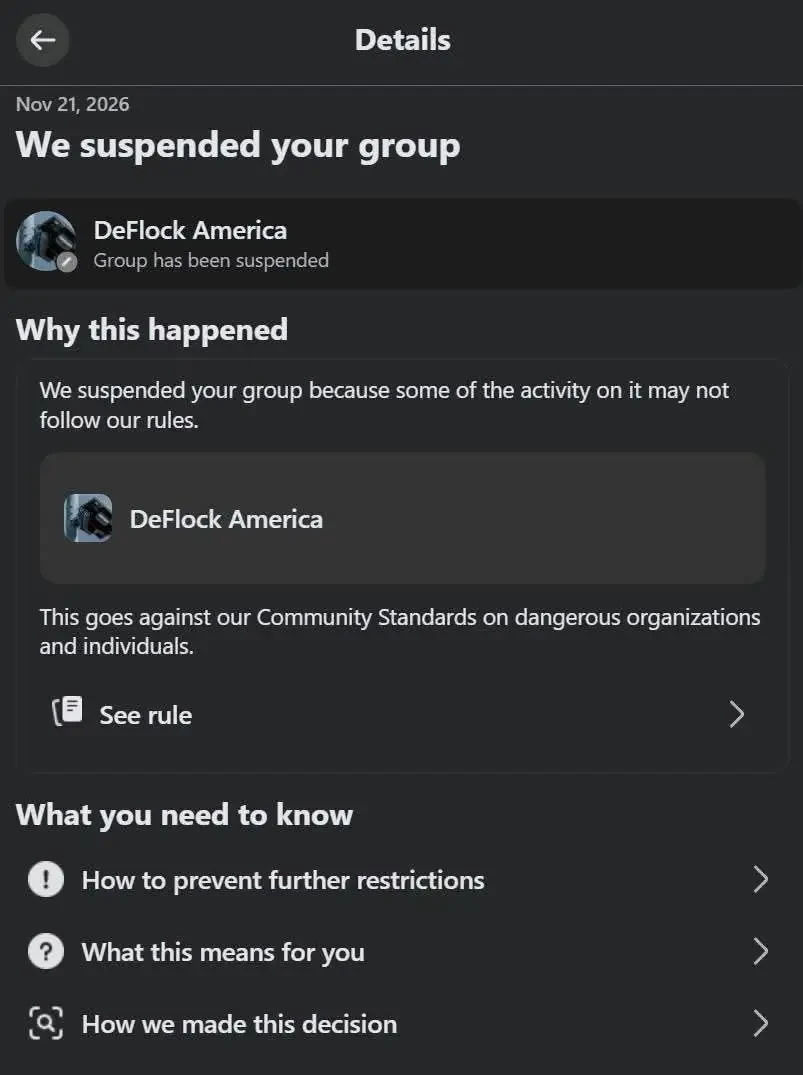
DeFlock Amerca Facebook Group Suspended as a Dangerous Organization
David Eduard (yesterday) The DeFlock America group with over 840k members has been suspended by Meta. What they can't block or suspend are the grassroots movements forming across America. Suspended for thought crimes. Wrongthink. wRSvf73q7rTiyuc.webp
Surveillance pricing uses our personal data to make us pay more
Algorithms often rely on data that reflect historical and ongoing biases, embedding these prejudices into wage- and price-setting systems and perpetuating them. For example, as studies of rideshare company platforms have shown, riders traveling to predominantly non-white neighborhoods are often charged higher prices,a pattern that mirrors historical residential segregation. And … college test-prep services have sometimes been priced over $1,000 more in zip codes with large Asian populations.

Snowden on steroids: AI agents in phones trigger surveillance fears
AI agents have already proven to be a cybersecurity risk. Now the privacy world is sounding the alarm.

 View on programming.dev