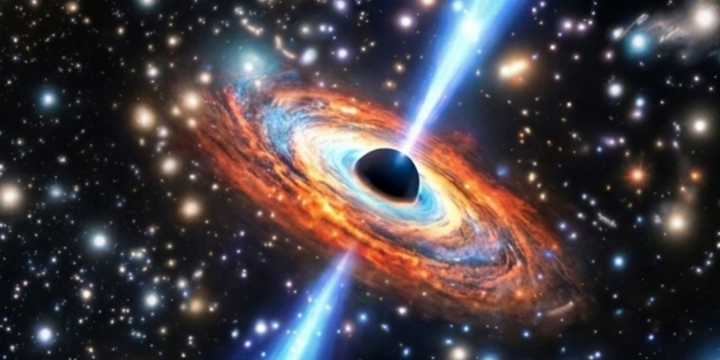
Two studies propose that dense star clusters in the early universe could have produced massive black-hole seeds, potentially explaining how supermassive black holes grew so quickly [sci.news][phys.org]. The James Webb Space Telescope has observed candidate young clusters, but researchers have not directly detected black holes forming in them [phys.org][lesnumeriques.com]. One model finds that repeated stellar mergers could build stars more than 200 times the Sun’s mass, while another estimates that clusters in the Cosmic Gems arc could produce black holes with masses of 1,600 to 2,700 times the Sun’s [sci.news][phys.org]. The studies also suggest that dense gas around black holes could help explain the early universe’s “Little Red Dots” [sci.news]. Cluster structure, rotation and the initial mass function remain uncertain [phys.org][lesnumeriques.com]. Highlights: • Different clusters: The separate model estimates smaller seed black holes of 180 to 810 solar masses in the less compact Firefly Sparkle clusters [phys.org][lesnumeriques.com]. • Collision threshold: In simulations by a team led by Claire Williams, a University of California, Los Angeles doctoral student, clusters with densities above roughly 100,000 solar masses per cubic parsec formed stars more than 200 times the Sun’s mass across nearly all tested low-mass systems [sci.news]. • Model checks: Researchers used a runaway-collision model that accounts for mass loss through stellar winds to estimate black-hole masses in Cosmic Gems and Firefly Sparkle, then checked the results against direct N-body simulations of compact clusters [phys.org]. "When a star this huge reaches the end of its life, models suggest that it may have no option but to collapse into itself and form a massive black hole" — Claire Williams, University of California, Los Angeles doctoral student Sources: • Ancient star collisions could explain mysterious Little Red Dots and 'impossible' black holes - space.com • Colliding Stars in Early Universe May Explain Stellar Monsters, Study Suggests - sci.news • JWST may have found where heavy black hole seeds formed - phys.org • Actualité : Origine des trous noirs supermassifs : le James-Webb aurait déjà observé comment ils se forment - lesnumeriques.com --- 📰 Story aggregated by Kagi News

Comments