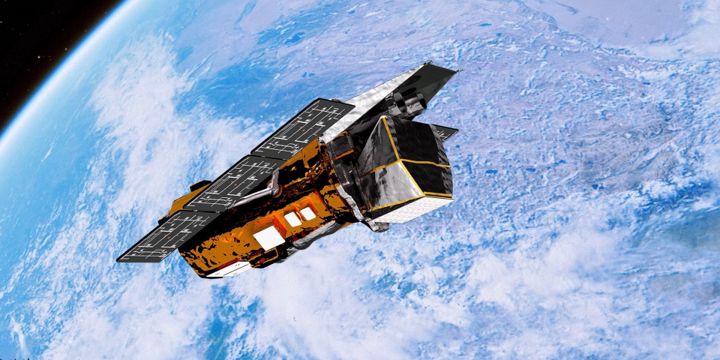
NASA’s Neil Gehrels Swift Observatory, a space telescope that studied gamma-ray bursts and other cosmic events, re-entered Earth’s atmosphere at 7:39 a.m. Eastern time on Nov. 4 over Indonesia’s North Sumatra province, ending a mission that lasted nearly 22 years [nasa.gov][reuters.com][dw.com]. The U.S. Space Force reported the re-entry location; NASA said most of the roughly 1,452-kilogram observatory was expected to burn up. The agency reported no damage or injuries on the ground after estimating the chance of debris harming anyone at about 1 in 2,100 [reuters.com][nasa.gov]. Swift launched in 2004 for a planned two-year mission. It detected more than 2,000 gamma-ray bursts, observed more than 1,400 supernovae and contributed data to about 7,000 scientific papers [science.org][reuters.com]. Its rapid alerts also let other observatories follow up on short-lived events [nasa.gov][scientificamerican.com]. Solar activity swelled Earth’s upper atmosphere, increasing drag on Swift, which had no propulsion system to raise its orbit [reuters.com][dw.com]. A NASA-backed rescue attempt failed after the robotic spacecraft LINK lost control and began spinning. Swift ended science operations on Oct. 20 [reuters.com][theconversation.com]. Researchers can continue working with the telescope’s archived observations [livescience.com]. Highlights: • Rapid response: Swift could turn across 50 degrees of sky in less than 75 seconds, allowing it to observe transient events while their afterglows were still visible [theconversation.com]. • Microlensing collaboration: In 2015, Swift teamed up with two other telescopes to observe a brown dwarf passing in front of a more distant star; the distortion of the star’s light helped researchers determine the brown dwarf’s size and mass [science.org]. • Early supernova signal: In 2008, Swift detected a rise in X-rays before a supernova explosion, capturing an early phase of supernova evolution [theconversation.com]. • Unexpected flare: Swift detected a 2014 gamma-ray flare from interacting binary stars that researchers considered a possible candidate for the brightest event seen from a red dwarf [science.org]. Perspectives: NASA: NASA Administrator Jared Isaacman said the agency should consider every reasonable option to keep the Hubble Space Telescope operating because it still has important science ahead [pbs.org]. (PBS NewsHour (Associated Press)) Katalyst Space Technologies: The company said LINK no longer had enough propellant to capture Swift and raise its orbit safely after engineers worked to slow the spacecraft’s uncontrolled spin [theconversation.com]. (The Conversation) Dean Sladen: The aerospace engineer argued that designing satellites for safe re-entry is increasingly important as the long-term risk of re-entry accidents grows [reuters.com]. "It's radiating more energy in that period than the sun will in its entire lifetime." — Brad Cenko, Swift principal investigator Sources: • NASA's 22-year-old Swift satellite telescope falls from orbit in fiery finale - reuters.com • NASA's Swift space telescope plunges back to Earth in fiery demise - dw.com • NASA’s Swift telescope plunges back to Earth - scientificamerican.com • OFFICIAL: NASA's Swift Observatory has today crash landed back on Earth, concluding a historic 22-year mission that provided significant discoveries about gamma-ray bursts, exploding stars and black-holes - reddit.com • Swift has fallen: NASA's 22-year-old space telescope burns up over Sumatra - livescience.com • NASA's Swift space telescope crashes back to Earth after failed rescue attempt - space.com • Goodbye Swift: After 22 years, NASA spacecraft burns up in atmosphere - science.org • NASA telescope plummets back to Earth - popsci.com • A NASA space telescope plunged back to Earth after a mission that lasted 11 times longer than planned - pbs.org • A fiery end to a NASA mission that captured some of the universe's brightest events - npr.org • NASA’s Swift Observatory has burned up in the atmosphere – the indispensable telescope helped astronomers track fast-moving events in space - theconversation.com • NASA space telescope plunges to Earth after two decades studying cosmic explosions - phys.org • NASA’s Swift telescope has burned up, months after a robot sent to save it failed - reddit.com • The Neil Gehrels Swift Observatory, a space telescope for studying gamma-ray bursts, re-enters Earth's atmosphere over Sumatra, ending its mission of nearly 22 years. - nasa.gov • NASA’s Swift telescope has burned up, months after a robot sent to save it failed – here’s why it’s so hard to boost a satellite - theconversation.com • A NASA Telescope Has Crashed Back to Earth - nytimes.com • NASA's Swift space telescope falls to Earth after 22-year mission - wam.ae • NASA’s 22-year-old Swift satellite telescope falls from orbit in fiery finale - ddindia.co.in • NASA’s Swift Observatory is about to burn up in the atmosphere – the indispensable telescope helped astronomers track fast-moving events in space - newspaceeconomy.ca • Nasa’s Swift satellite telescope falls from orbit in final fiery plunge - scmp.com • NASA's Swift Observatory Is Falling to Earth - slashdot.org • Nasa's Swift satellite telescope heads for fiery re-entry 22 years after launch - dawn.com • NASA's Swift satellite telescope heads for fiery re-entry 22 years after launch - tribune.com.pk • Nasa's 3,200-pound Swift telescope crashes to Earth after 22 years in space - indiatimes.com • NASA’s 3,200-Pound Space Telescope Falls Back to Earth After 22 Years - insiderpaper.com • NASA'nın Swift Gözlemevi kontrolsüz biçimde düşüyor: Endonezya yakınlarında atmosfere girdi - birgun.net • El Swift, telescopio de la NASA, se despide entre llamas sobre Sumatra - unomasuno.com.mx • NASA’s 22-year-old Swift telescope burns up over Indonesia - minutemirror.com.pk • Ruimtetelescoop Swift na 22 jaar en mislukte reddingsactie vergaan in dampkring - nu.nl • NASA: американский телескоп Swift сошёл с орбиты и сгорел в атмосфере - rt.com • Nasa-Satellit »Swift« auf Erde gestürzt - spiegel.de • El telescopio Swift cae a la Tierra tras fracasar la misión de rescate de la Nasa - elcorreo.com • Kính viễn vọng không gian Swift bốc cháy khi rơi trở lại Trái Đất - vietnamplus.vn • بعد 22 عاما من رصد الانفجارات الكونية.. سقوط "سويفت" - skynewsarabia.com • Teleskop Swift spłonął w atmosferze po 20 latach pracy - benchmark.pl • Teleskop Swift shořel v atmosféře. Kusy dopadnou na Zemi - novinky.cz • Satelliitit | Nasan vuosikymmeniä vanha teleskooppi putosi Maahan - hs.fi • Automatická observatoř NASA Swift se po dvaadvaceti letech služby na oběžné dráze vrací domů. V plamenech - denikn.cz • Nasa-Satellit „Swift“ nach gescheiterter Rettungsmission auf Erde gestürzt - sn-online.de • Telescopul spațial Swift reintră în atmosferă și e distrus, după 22 de ani în spațiu: NASA a încercat să-l salveze în vară - digi24.ro • Spadł na Ziemię. Teleskop Swift zakończył swoją misję - wp.pl • Vesmírný tahač nepomohl. Teleskop Swift ve středu shořel v atmosféře - lidovky.cz • Nasa-Satellit «Swift» auf Erde gestürzt - bluewin.ch • NASA’nın Swift Gözlemevi Dünya’ya düşüyor - havadiskibris.com • NASA'nın Swift Gözlemevi Dünya'ya düşüyor - gazeteoksijen.com • NASA's 22-Year-Old Telescope Falls From Orbit Over Indonesia After Failed Rescue Mission - news18.com • NASA'ya ait Swift Gözlemevi Dünya'ya düşüyor - karar.com • Nasan vuosikymmeniä vanha teleskooppi putosi Maahan - is.fi • NASA-telescoop Swift na 22 jaar vergaan in de atmosfeer - vrtnws.be • NASA雨燕天文台墜入大氣層 22年太空任務烈焰中謝幕 - cna.com.tw • Nach gescheiterter Rettung - NASA-Himmelsobservatorium "Swift" in der Erdatmosphäre verglüht - deutschlandfunk.de • NASA telescope is on the verge of plunging back to Earth after failed rescue mission - nagariknetwork.com • Space Force confirms NASA's Swift re-entered at 12:39 UTC Nov 4 over North Sumatra (3.4° N, 98.6° E) - reddit.com --- 📰 Story aggregated by Kagi News

Comments