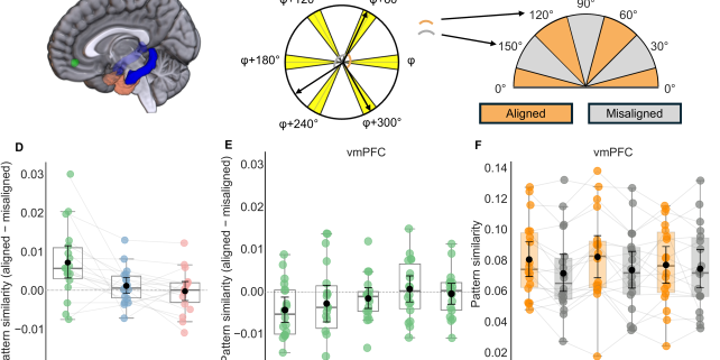
Neuroscientists Marshall Devor and Mark Baron propose that the brainstem generates the basic feeling of conscious existence, while the cortex organizes more complex perceptions and thoughts. Their paper synthesizes clinical cases and earlier animal experiments rather than reporting a new experiment. They argue that pain and consciousness can persist after extensive cortical damage, while small injuries to the upper brainstem can cause coma [psypost.org]. Separately, a study using functional magnetic resonance imaging in 18 people found a sixfold, hexagonal activity pattern in the ventromedial prefrontal cortex as participants evaluated facial expressions and emotional phrases. The researchers say the pattern may help organize relationships among emotions, but the small study does not establish that it causes emotional processing [sciencealert.com]. Highlights: • Animal evidence: Earlier rat experiments involving 828 microinjections across 182 animals linked anesthesia's effects to a tiny upper-brainstem node; larger toxin-induced injuries around it caused irreversible coma in six rats [psypost.org]. • Emotion study design: Participants evaluated transitions across the affective circumplex, a map organized by emotional pleasantness (valence) and activation (arousal) [sciencealert.com] • Cortical stimulation: In awake patients, stimulating visual, auditory or touch areas can evoke flashes, sounds or tingling, but rarely pain; one study of the insula evoked pain at only 8 of 313 sites [psypost.org]. "These findings suggest that emotion knowledge is structured by a grid-like coordinate system in the human brain." — Neuroscientists Yumeng Ma and Philip A. Kragel Sources: • The newest consciousness research points to the brainstem, not the cortex - reddit.com • Neuroscientists propose a surprising new home for consciousness - psypost.org • The Human Brain May Organize Emotions Using a Hexagonal Grid - sciencealert.com --- 📰 Story aggregated by Kagi News

Comments